When Procedure started on 23rd February, 2017, it began as a small team working out of a single room. Culture back then wasn't something we built deliberately. It was a side effect of proximity - everyone heard the same conversations, trust was visible because you could watch it happen, and alignment took care of itself when context traveled across one table.
Nearly eight years later, that room had turned into a distributed team across India, working across time zones, Slack threads, and multiple reporting layers. The founders weren't in every conversation anymore. And somewhere in that growth, a question started nagging at us that we couldn't answer internally: Does our culture actually hold up at this scale, or does it just feel that way because the people who built it are still around?
Public signals were encouraging - our team had consistently rated us highly on platforms like AmbitionBox and Glassdoor. But external perception isn’t the same as internal truth.
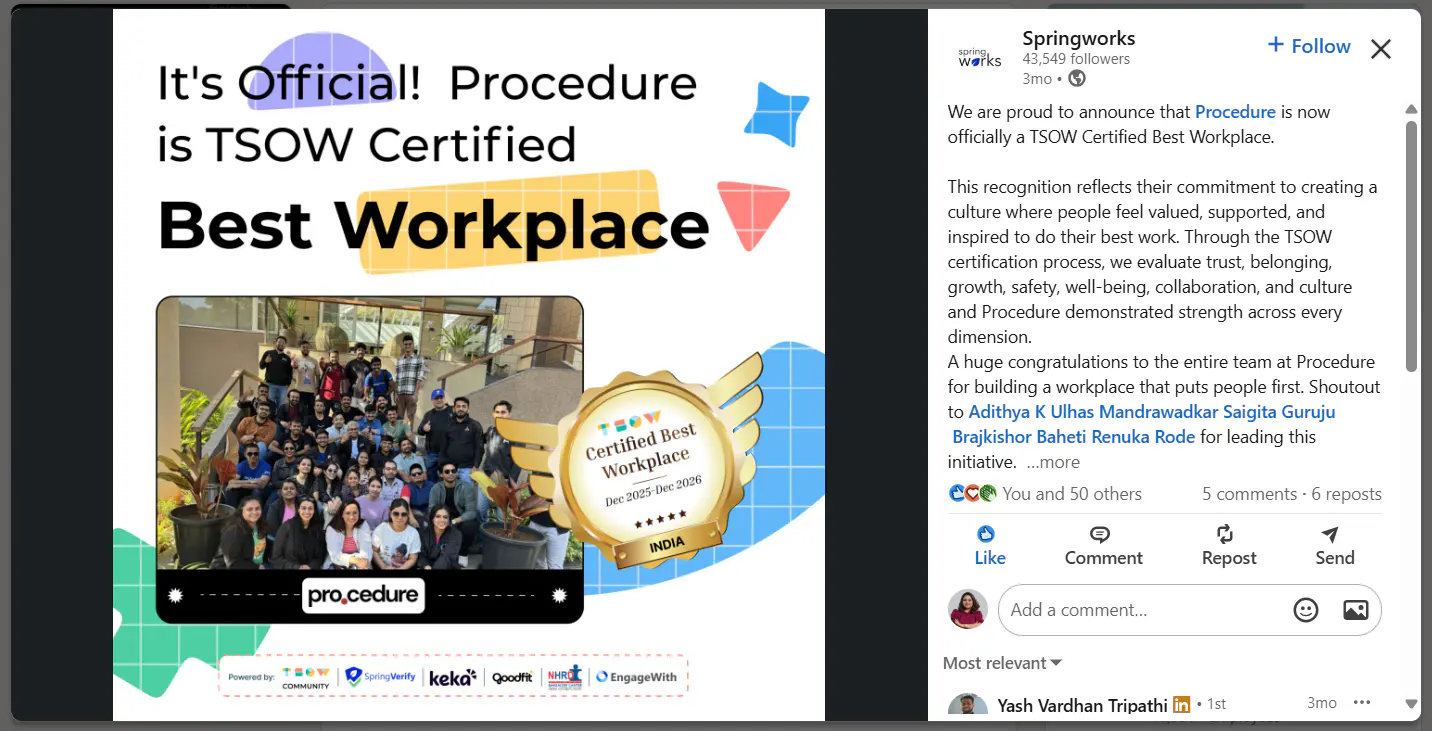
We pursued a Best Place to Work certification to find out, not for the badge, but for the answer.
Why We Waited 8 Years Before Running an Employee Engagement Survey
In early-stage companies, culture almost always feels strong. Friction is low, founders are involved in everything, and psychological safety appears high because everyone knows each other. But that safety is proximity-dependent. It hasn't been tested under scale.
We deliberately delayed a formal culture audit for nearly eight years. Early certifications tend to measure momentum and intent rather than resilience, and resilience was what we actually cared about. We wanted to wait until teams could operate independently, ownership had extended beyond founders, disagreements felt safe without escalation, and systems rather than personalities drove trust. Only then would an employee engagement survey tell us something meaningful about organizational culture.
How We Evaluated Workplace Culture Certification Programs
We evaluated several certification frameworks before choosing. Some primarily function as brand markers. We were looking for scrutiny rather than signaling.
Best Place to Work stood out because it required a genuinely anonymous employee engagement survey with a high qualification benchmark, external evaluation with structured leadership discussions, and independent validation beyond internal narratives. The deciding factor was simple: if culture requires explanation from leadership to feel coherent, it hasn't matured yet. We wanted to see how culture was actually experienced across teams, without context being softened by founders.
What 98% Survey Participation Tells You About Organizational Culture
The most important signal wasn’t the headline score but participation - 98% of the team responded.
That level of participation signals something foundational - people believe their voice is safe. The overall results were strong:
- 92%+ positive responses overall
- 90%+ on trust and psychological safety
- 95%+ on belonging and collaboration
- Leadership credibility above 90%
But averages weren't our primary focus. We looked for variance. In scaling companies, culture rarely collapses dramatically. It erodes asymmetrically - one team at a time, one reporting line at a time. So we examined where scores dropped sharply between teams, whether psychological safety varied by role, and whether trust depended on individual managers rather than the organization. The absence of sharp drops mattered more than the percentages themselves. Consistency across distributed teams is significantly harder to manufacture than broad optimism.
How Psychological Safety Works in a Distributed Engineering Team
Psychological safety is not a policy statement; it is accumulated proof, reinforced through moments where people take a risk, and nothing negative follows.
At Procedure, our engineers challenge scope and timelines without hesitation. Feedback flows laterally, not just downward. Our distributed engineering teams own outcomes end-to-end rather than executing instructions. Disagreements get resolved within the team instead of escalating up the hierarchy. These aren't aspirational statements - they're reflections of how we've structured our culture from day one.
This is rooted in a principle that has shaped us from the beginning:
Engineers first. Technologies later.
We invest in judgment before frameworks, learning before tools, and ownership before rigid process. Failure is addressed early and openly - without blame, but never without accountability. The survey confirmed this pattern is experienced consistently across the organization, not selectively. That consistency is what allows distributed teams to deliver without constant supervision.
What an Independent Culture Assessment Found About Our Leadership
Beyond the survey, an external evaluator conducted an independent culture assessment - testing whether internal perception aligns with observable behavior.
The audit examined leadership accessibility, decision-making transparency, whether psychological safety is systemic or manager-dependent, and whether trust holds under pressure. The conclusion wasn't that we're perfect. It was that our culture is behavior-led rather than policy-heavy, and leadership credibility is reinforced through action rather than narrative. No signs of artificially inflated sentiment. Feedback patterns appeared steady and grounded across teams and tenure groups.
The Trade-offs of Protecting Workplace Culture During Growth
Maintaining cultural consistency has required deliberate trade-offs:
- Declined profitable work when it threatened long-term team sustainability
- Passed on capable candidates when alignment felt uncertain
- Slowed hiring during periods when clarity lagged behind ambition
These decisions are rarely visible externally, but internally, they compound. Speed without clarity creates silent debt. Inconsistent rules erode trust faster than difficult work ever does. Protecting workplace culture has occasionally meant choosing long-term integrity over short-term acceleration, and those choices are a big part of why our client partnerships tend to last years rather than months.
Where We Still Have Gaps - And Why That's the Point
The survey wasn't silent on gaps. Role clarity, growth progression, compensation expectations, and decision speed all surfaced as areas needing attention. These are common inflection points for organizations transitioning from founder-driven to distributed leadership structures.
The presence of friction isn't a red flag. Silence is. Cultural resilience depends less on perfection and more on responsiveness. The fact that these gaps showed up clearly, and that the team felt safe enough to surface them, tells us more about the culture's health than any positive score could.
What the Best Place to Work Certification Actually Means for a Growing Company
Becoming a certified Best Place to Work is not a conclusion. It's a checkpoint.
It confirms that the systems built around trust, ownership, clarity, and psychological safety are holding at the current stage of growth. As Procedure continues to scale, the objective remains unchanged: build an organizational culture that doesn't rely on supervision, personality, or constant founder presence. Trust has to be systemic. Psychological safety has to survive growth. Alignment has to persist even as layers form.
The certification didn't create that system. It confirmed its functioning. And that gives us something more useful than a badge - a clear picture of where to focus next.
If you're an engineer who values ownership and autonomy, see what we're building and who we're looking for.

Adithya K
Talent Acquisition Specialist (TA3)
Adithya works across hiring, culture, and people systems at Procedure. He builds structured evaluation frameworks and scalable processes that strengthen team quality and long-term organizational growth, with a focus on transparency and consistency in how people systems operate.