
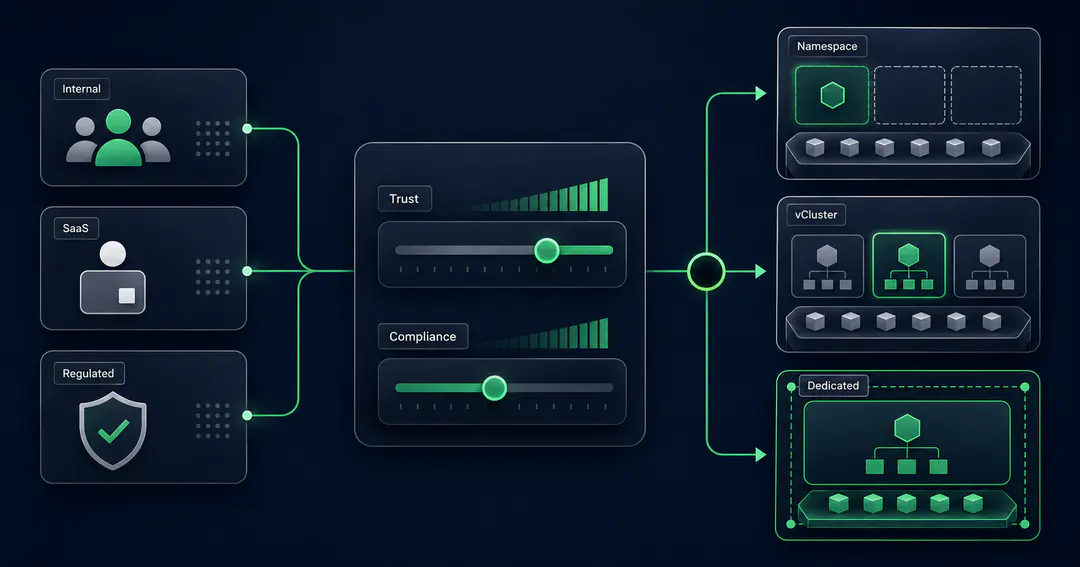
Most Kubernetes multi-tenancy advice answers the wrong question. It jumps straight to how: which tool, which controller, which YAML. The question that actually decides your architecture is simpler and comes first. How much isolation does each tenant need? And the honest answer is that it differs for an internal team, a free-tier SaaS user, and a bank running regulated workloads on your platform.
Get that wrong in one direction and you over-build: dozens of dedicated clusters, each with its own upgrade cycle and bill, for tenants who already trust each other completely. Get it wrong in the other direction and you get false confidence: one shared cluster with a namespace per customer and a network policy, sold internally as isolation it does not actually provide.
This guide is a decision framework, not a tool tour. It is written for the people who own the platform decision, the engineering leads and platform teams, and it works backward from the two things that should drive the choice: how much you trust each tenant, and how much compliance exposure they carry.
Multi-Tenancy Is Not One Decision
The first mistake is treating multi-tenancy as a single switch you flip for the whole platform. It is not. The Kubernetes documentation itself frames the hard-versus-soft distinction as a spectrum rather than two boxes, because there is no single set of primitives that answers every case at once.
Start from the namespace, because it is the backbone of almost everything else in Kubernetes. RBAC, resource quotas, and network policies all respect namespace boundaries, and that makes the namespace the natural unit of separation. What it is not is a security boundary. The Kubernetes RBAC guidance is blunt about this: boundaries within a namespace should be considered weak. A namespace keeps tidy teams out of each other's way. It does not, on its own, stop a determined or compromised tenant.
So the real work is matching the strength of the boundary to the tenant behind it. Three questions decide almost every case. Do you trust this tenant not to attack the others? Does this tenant carry compliance weight that an auditor will inspect? And does this tenant need to manage cluster-level resources of its own, like custom resource definitions? Hold those three in mind, because the models below map directly onto them.
The Three Isolation Models
Namespace-Based Isolation (Soft Multi-Tenancy)
This is the default and, for a lot of teams, the right answer. Each tenant gets a namespace, and you wrap it in the standard controls: RBAC to scope access, resource quotas and limit ranges to stop one tenant starving the rest, network policies to control traffic, Pod Security Standards to constrain what pods can do, and a policy engine to enforce all of it automatically. Capsule is worth knowing here: it turns namespaces into a self-service, tenant-aware abstraction so platform teams are not hand-rolling every tenant.
What it is good for: internal, trusted teams sharing one platform. Colleagues, not customers.
The honest weakness is the shared control plane and the shared kernel. A namespace is an administrative boundary, not a security one. A container escape or a kernel exploit crosses it, and no amount of extra admission policy closes that gap. There is also the control-plane noisy-neighbor problem, where one tenant hammers the API server and degrades everyone. That one is already solved by API Priority and Fairness, stable in recent Kubernetes releases, so you do not need a heavier model to fix it.
One landmine to avoid. If you research this topic you will still find guides pointing to the Hierarchical Namespace Controller for nesting namespaces under teams. That project was archived in April 2025 and is no longer maintained. Do not build on it. Use Capsule for the tenant abstraction and a policy engine for the guardrails instead.
Virtual Clusters (vCluster)
The middle ground, and the model that has matured the most. A virtual cluster gives each tenant its own Kubernetes API server and control plane, running as ordinary pods inside a host namespace. The tenant gets their own CRDs, their own RBAC, their own view of a cluster. From the host's side, the whole thing is just workloads in a namespace. vCluster, from Loft Labs, is the dominant implementation of this in 2026.
What it solves that namespaces cannot: control-plane isolation and CRD autonomy. A tenant can install cluster-scoped resources and their own controllers without touching yours, and without you handing out cluster-admin on the real cluster. That single capability is why so many teams stop building a cluster per team and consolidate onto vClusters instead.
The isolation you get depends on the node model you choose. Shared nodes give you the cheapest, densest option where tenants share the host's compute. Dedicated nodes pin a tenant's workloads to their own node pool. Private nodes go further, with their own networking and storage stack, approaching what a real cluster feels like. The honest weakness: unless you move up to dedicated or private nodes, tenants still share the kernel and the underlying nodes. vCluster gives you strong control-plane isolation. It does not, by itself, give you kernel isolation. That is a separate decision, covered below.
Dedicated Clusters (Hard Multi-Tenancy)
Separate control plane, separate nodes, separate everything. This is the strongest boundary and the most expensive one to run.
What it is for: untrusted or hostile tenants, hard compliance boundaries, and cases where you need strong blast-radius and performance guarantees that only physical separation provides.
The honest weakness is cost and sprawl. Every cluster is another upgrade cycle, another set of add-ons to patch, another bill, another thing to monitor. The common failure mode is reaching for a dedicated cluster by default, for every team, and then drowning in the operational overhead of running dozens of them. Teams that start there almost always end up consolidating later. Dedicated clusters are a tool for the tenants that genuinely need them, not a starting position.
The Layers That Apply No Matter Which Model

The three models decide the shape of the boundary. These layers decide how strong it actually is, and they apply regardless of which model you pick.
Runtime isolation. If untrusted workloads share nodes, the container boundary alone is not enough, because a kernel exploit crosses it. Sandboxed runtimes close that gap. gVisor intercepts syscalls in a user-space kernel, and Kata Containers runs each pod in a lightweight virtual machine. For untrusted tenants that are not on dedicated clusters, this is not optional. It is the layer that turns a soft boundary into a real one.
Network isolation. Network policy is the baseline, and the only sane default is deny-by-default with explicit allows. Cilium adds L3 to L7 policy and eBPF-based visibility, which matters both for finer control and for producing the audit trail a compliance review will ask for.
Policy enforcement. You cannot hand-check every tenant's manifests. A policy engine like Kyverno, which graduated within the CNCF in early 2026, or OPA Gatekeeper enforces the hygiene automatically: no privileged pods, no running as root where it is not allowed, a quota and a network policy present on every tenant namespace. Set it once and it holds the line for you.
Why this layer matters is not theoretical. Recent history keeps proving that shared, cluster-scoped resources are a shared blast radius. The IngressNightmare vulnerability and the broader churn around shared ingress controllers were a reminder that a component every tenant shares is a component every tenant can be hurt by. Treating a shared resource as a tenant boundary is exactly the false confidence this guide is trying to help you avoid.
The Decision Framework: Trust and Compliance
This is the core of the framework. Do not pick one model for the platform. Score each tenant on two axes and apply the lightest model that clears the higher of the two.
The first axis is trust: is this an internal team, an external customer, or an untrusted or potentially hostile tenant? The second is compliance exposure: none, a general framework like SOC 2, or a hard regulatory boundary like PCI or HIPAA. A tenant that is low on both can live in a namespace. A tenant that is high on either needs a stronger model, and the cross-cutting layers to match.
| Tenant profile | Model | Add these layers |
|---|---|---|
| Internal trusted teams, low compliance | Namespaces + quotas + policy engine | Network policy, RBAC |
| Trusted teams that need their own CRDs or K8s version | vCluster on shared nodes | Network policy, quotas |
| External customers, moderate trust | vCluster on dedicated nodes | Runtime sandbox (gVisor or Kata), Cilium L7 |
| Untrusted or hard-regulated (PCI, HIPAA) | Dedicated nodes or dedicated cluster | Runtime sandbox, dedicated network path, strict audit |
Use the table as a starting point, not a fixed rulebook. The real decision is per tenant: how much do you trust them, and how much compliance risk do they carry?
SaaS Versus Enterprise-Internal: Two Default Paths
The framework lands differently depending on who your tenants are.
If you run a SaaS platform, tenants are customers and per-tenant cost is a product decision, not just an infrastructure one. The usual shape: namespaces for free and low tiers where tenants are low-risk and margin is thin, virtual clusters for paid tiers that need autonomy or stronger separation, and dedicated clusters reserved for the handful of enterprise contracts that both require and pay for single-tenancy. Mixing models across tiers is not messy, it is the correct answer. It matches spend to what each tier is worth.
If you run an enterprise-internal platform, tenants are teams of employees who all, broadly, trust each other. Namespaces are usually enough. Move a team onto a virtual cluster when they genuinely need their own CRDs or a different Kubernetes version, not as a reflex. The discipline here is the opposite of the SaaS case: resist buying isolation you do not need, because every extra layer is operational cost your platform team pays forever.
Where Teams Get It Wrong
Four patterns show up again and again.
Treating a namespace as a compliance boundary. It is not, and auditors increasingly know the difference between an administrative boundary and a real one. If a regulated workload sits in a namespace next to everything else, expect that to come up in review.
Over-isolating everything into dedicated clusters and calling the resulting sprawl security. Most of it is just cost. Isolation you cannot operate well is not more secure, it is more fragile.
Forgetting quotas, so one tenant quietly starves the rest. This is a reliability problem and a cost problem at the same time: unbounded tenants are exactly where Kubernetes spend leaks, which is a big part of Kubernetes cost optimization. A quota per tenant is the cheapest control you will ever add. To right-size those quotas honestly you need real per-tenant usage data, the same measurement layer covered in Prometheus monitoring at scale.
Assuming vCluster gives you runtime isolation. It gives you control-plane isolation, which is real and valuable, but the kernel is still shared unless you chose dedicated or private nodes. Knowing exactly which boundary a tool provides is the whole game.
How to Actually Decide: A Short Playbook
- List your tenants and score each on trust and compliance exposure.
- Default every tenant to the lightest model that clears the higher of its two scores.
- Add runtime sandboxing for anything untrusted that shares nodes.
- Make network policy deny-by-default and enforce it, plus the rest of your hygiene, with a policy engine.
- Give every tenant a resource quota and per-tenant usage and cost visibility.
- Revisit yearly. Trust levels and compliance scope change, and the model should change with them.
Multi-tenancy is a series of per-tenant decisions, not a product you switch on. If you are staring at cluster sprawl, or you are not sure whether your namespace isolation would survive an audit, that is exactly the review worth doing before you add one more cluster. Procedure's platform engineering team runs Kubernetes isolation and platform work across production environments, and can help with a review of your Kubernetes tenant isolation model: where a namespace is fine, where a virtual cluster earns its keep, and where nothing short of a dedicated boundary will pass.
Follow our engineering work on LinkedIn.
Frequently Asked Questions
Is namespace isolation enough for Kubernetes multi-tenancy?
It depends on trust. For internal, trusted teams, a namespace with RBAC, resource quotas, network policies, and a policy engine is a reasonable and cost-effective answer. For external or untrusted tenants it is not, because a namespace is an administrative boundary rather than a security one, and a container escape or kernel exploit crosses it. Those tenants need virtual clusters, runtime sandboxing, or dedicated clusters.
What is the difference between namespaces and virtual clusters?
A namespace shares the host cluster's single control plane. A virtual cluster, using a tool like vCluster, gives each tenant its own API server, CRDs, and RBAC while still scheduling workloads onto shared host nodes. Virtual clusters add control-plane isolation and CRD autonomy that namespaces cannot provide, at a much lower cost than running separate clusters. They do not, on their own, isolate the kernel.
When do you need a dedicated cluster per tenant?
When the tenant is untrusted, when the compliance boundary is hard (PCI, HIPAA, or a contractual single-tenancy requirement), or when you need strong blast-radius and performance guarantees. Dedicated clusters give the strongest isolation and carry the highest operational cost, so reserve them for tenants who genuinely require and fund that level rather than applying them by default.
Can Kubernetes multi-tenancy meet compliance requirements like PCI or HIPAA?
Yes, but rarely with namespaces alone. Hard compliance boundaries usually need runtime isolation with gVisor or Kata Containers, strict network segmentation, and often dedicated nodes or clusters for the regulated workloads. The safe pattern is to isolate the regulated tenant more strongly than the rest, rather than raising the entire platform to that bar and paying for it everywhere.
Procedure Team
Engineering Team
Expert engineers building production AI systems.